Technology
The Laboratory Report That Passed Every File Check but Failed the Experiment: Why Digital Records, Lot Numbers and Certificate Verification Still Matter in Modern Research
By BrightsFuture
November 9, 2026
Field Notes
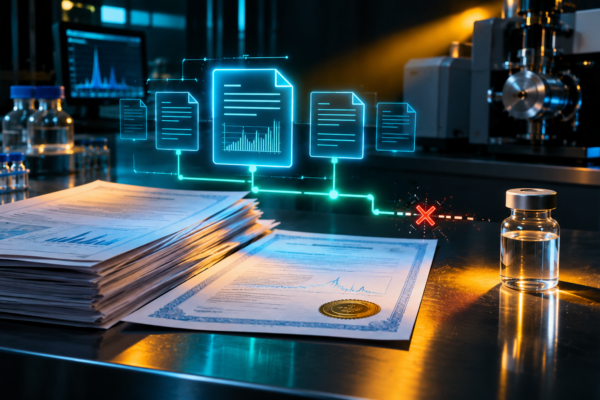
A research team can receive a certificate of analysis, store it in the correct folder, and still be unable to establish whether that report describes the sample used in an experiment. The document might be genuine. The numbers might be accurately transcribed. The problem may be a missing connection between a physical material, its lot identifier, and the record that supposedly supports it.
This is a data-management failure as much as a laboratory problem. It becomes harder to detect when procurement files, analytical reports, inventory records, and experimental observations live in separate systems. A successful file upload does not verify a sample. A searchable PDF does not establish that its contents apply to the material on a laboratory bench.
What a document check can miss
Consider a hypothetical research group purchasing two batches of the same laboratory reagent several weeks apart. A certificate arrives for the first batch, and an administrator saves it under the material’s product name. When the second delivery arrives, the inventory system shows the same product name. A researcher retrieves the first document because it appears to match the item being studied. The experiment later gives a result that differs from an earlier run.
None of those steps requires a forged report or deliberate misconduct. The file may be authentic and the laboratory analysis behind it may be sound. Yet the report cannot establish the properties of the second batch unless there is evidence connecting that specific batch or sample to the analysis. A filename based on a product name is not enough.
The World Health Organization’s 2011 Laboratory Quality Management System handbook treats sample tracking and record maintenance as essential parts of investigating laboratory problems. Its guidance was written for health laboratories, so it should not be mistaken for a rule that applies identically to every research operation. The underlying recordkeeping problem is broader: an investigation needs to reconstruct which material was examined, when, and on what basis.
Digital systems are often judged by whether a file was uploaded, a field was completed, or a report was approved. Those are useful process checks, but they answer different questions from the one a scientist needs answered: does this evidence belong to this exact material?
The missing connection between a certificate and a sample
A certificate of analysis, often shortened to COA, records analytical findings for an identified material or sample. Its meaning depends on details that may receive less attention than a headline purity figure: the sample identifier, lot or batch reference, issuing laboratory, test date, method, and stated measurement. Each detail helps establish what the document can support.
For example, high-performance liquid chromatography can separate components and provide a result under specified conditions. A chromatographic area percentage does not automatically establish a material’s identity, total content, sterility, or suitability for an intended investigation. Different questions require appropriate methods and evidence. A report can be useful within its stated scope without answering every possible quality question.
That is why a practical explanation of this guide to reading laboratory certificates begins with the identity of the material and the report’s lot reference rather than treating a single number as the whole answer. Readers should establish what was tested before interpreting what the measurement means.
A further complication is the difference between a supplier’s lot identifier and a laboratory’s internal sample identifier. An outside testing laboratory may assign its own reference when it receives a specimen. Unless the records explicitly connect those identifiers, a researcher may not be able to trace the result to the received material. The necessary connection can be documented through sample submission records, receiving logs, or an equivalent traceable system, depending on the organization.
The goal is not to collect identifiers for their own sake. It is to preserve a defensible path from a physical sample to the analytical evidence associated with it. If one part of that path is missing, the right response is to resolve the discrepancy, not to infer a match because the compound name looks familiar.
Why lot numbers are research data
Lot numbers are sometimes treated as a warehouse concern. In research, they can also be important experimental metadata. Two containers with the same product description may have different manufacturing, packaging, shipping, and testing histories. Those differences do not prove the batches perform differently, but they may matter when a team investigates unexpected results.
Suppose a laboratory repeats an assay with a newly delivered reagent. The instrument settings, researcher, and analysis script are unchanged. The recorded outcome shifts. Before concluding that the scientific hypothesis was wrong, the team should examine plausible sources of variation, including the identity and history of the materials used. A missing lot reference can prevent that comparison.
A focused discussion of why lot numbers matter in research explains how a batch identifier connects received material to related documentation. That relationship matters particularly when an organization needs to determine whether a question concerns one item, a shipment, or a broader production lot.
Researchers should preserve lot information where experimental results are recorded, not only where purchases are approved. An invoice may help reconstruct a transaction, but it is a poor substitute for a contemporaneous sample record. The same principle applies when one batch is divided among several experiments or multiple research groups share an inventory.
A lot number is not a guarantee of quality. It is an address within a traceability system. Its value depends on accurate labeling, controlled records, and a reliable link to the physical material. A perfectly formatted identifier that cannot be connected to any report or receipt gives the researcher little additional confidence.
Digital organization is not the same as data integrity
Cloud storage, document-management platforms, and laboratory information systems can make records easier to find. They may also introduce a false sense of completeness. A team can maintain an immaculate folder structure while storing outdated certificates, duplicate versions, or reports whose identifiers do not match the inventory.
The FAIR Guiding Principles, published by Mark Wilkinson and colleagues in Scientific Data in 2016, describe scientific data as Findable, Accessible, Interoperable, and Reusable. The principles focus on stewardship and the ability of people and machines to locate and interpret research resources. They do not certify that a scientific claim is true. They are useful here because searchable, interpretable records need context, relationships, and clear metadata.
Think of the difference between naming a PDF “reagent-report-final” and recording its source, version, material identity, lot, sample reference, analytical method, and applicable date. The first name may help a person locate a document. The second approach creates the conditions for testing whether the document belongs in a particular research record.
Version control matters, too. If a testing laboratory issues a corrected report, an organization needs to distinguish the revision from the earlier copy and understand what changed. Silently replacing a file can erase useful history. Keeping every version without a clear designation can cause a different problem: someone may unknowingly rely on an obsolete result.
The U.S. Food and Drug Administration’s guidance on 21 CFR Part 11 discusses electronic records and signatures within a defined regulatory scope. It should not be represented as a universal legal requirement for every independent laboratory or research purchase. For organizations actually subject to applicable FDA recordkeeping rules, the guidance emphasizes the continuing force of underlying record requirements and appropriate controls. For other organizations, it provides a useful comparison, not automatic regulatory jurisdiction.
What an effective verification workflow actually checks
A credible record check should begin before the material is used in an investigation. The exact workflow depends on the scientific field and applicable institutional procedures, but a disciplined review can ask a small number of direct questions:
- Does the material name on the report correspond to the label on the received item?
- Can the lot or sample identifier be matched without guessing or substituting a similar reference?
- Is the issuing laboratory identifiable, and does the record provide a test date?
- Which analytical method was used, and what characteristic was it designed to measure?
- Is the available record the applicable version for the material being considered?
- If a discrepancy appears, is there a documented route to investigate it before relying on the report?
These questions should not turn into a box-ticking exercise. A positive answer may still require supporting documentation, and a missing answer may justify further investigation rather than an immediate conclusion about the material. A certificate with a clear analytical scope remains valuable even when it has limitations. What matters is whether the researcher understands those limits.
One useful starting reference is USA Peptide Depot’s documentation checklist, which emphasizes matching the product and lot, identifying the laboratory, reviewing test dates, and understanding the method listed in a report. It is an educational resource, not an independent certification of any supplier’s operations or the safety of a research material.
A sound workflow also leaves room for escalation. If a sample label is damaged, a report is missing, or a lot number points to a different material, the team needs a way to record the discrepancy and request clarification. Quietly editing a spreadsheet cell until two records appear to agree defeats the purpose of traceability.
Why the failure may appear only after the experiment
Recordkeeping errors often have delayed consequences. A missing identifier may seem harmless when a delivery arrives. Months later, an unexpected measurement prompts a review, and the original materials have already been consumed. At that point, an inventory entry with an ambiguous lot number cannot be repaired simply by downloading the latest certificate from a website.
This is why contemporaneous records matter. A research team should be able to tell which batch was used for a given experiment, what supporting evidence was available at that time, and whether there were recorded exceptions. The practical standard is not an elaborate software purchase. Even a modest system can preserve reliable links between materials, documents, and experimental entries if the people using it follow consistent procedures.
The strongest digital design also makes mistakes visible. An unmatched sample identifier should appear as an unresolved discrepancy, not disappear into a completed-workflow dashboard. A missing test date should remain missing until documented evidence supplies it. An interface that rewards every record being marked complete can encourage false certainty if it does not allow users to record uncertainty honestly.
Science depends on the ability to question an observation and return to the evidence behind it. When a result changes, the inquiry should be able to reach past the graph and the spreadsheet to the identity of the material that entered the study. If that connection cannot be made, the limitation belongs in the interpretation of the experiment.
The most important document is not necessarily the report with the neatest formatting or the largest number on its first page. It is the report whose origin, scope, version, and relationship to the tested material can be reconstructed. Digital records are valuable when they preserve that relationship, not merely when they make a folder look complete.