

Key Takeaways
• Expect real HVAC repair to start with diagnosis, not guesswork. A solid residential service visit in Jacksonville should check the thermostat, filter, condensate line, blower motor, and outdoor unit before anyone talks replacement.
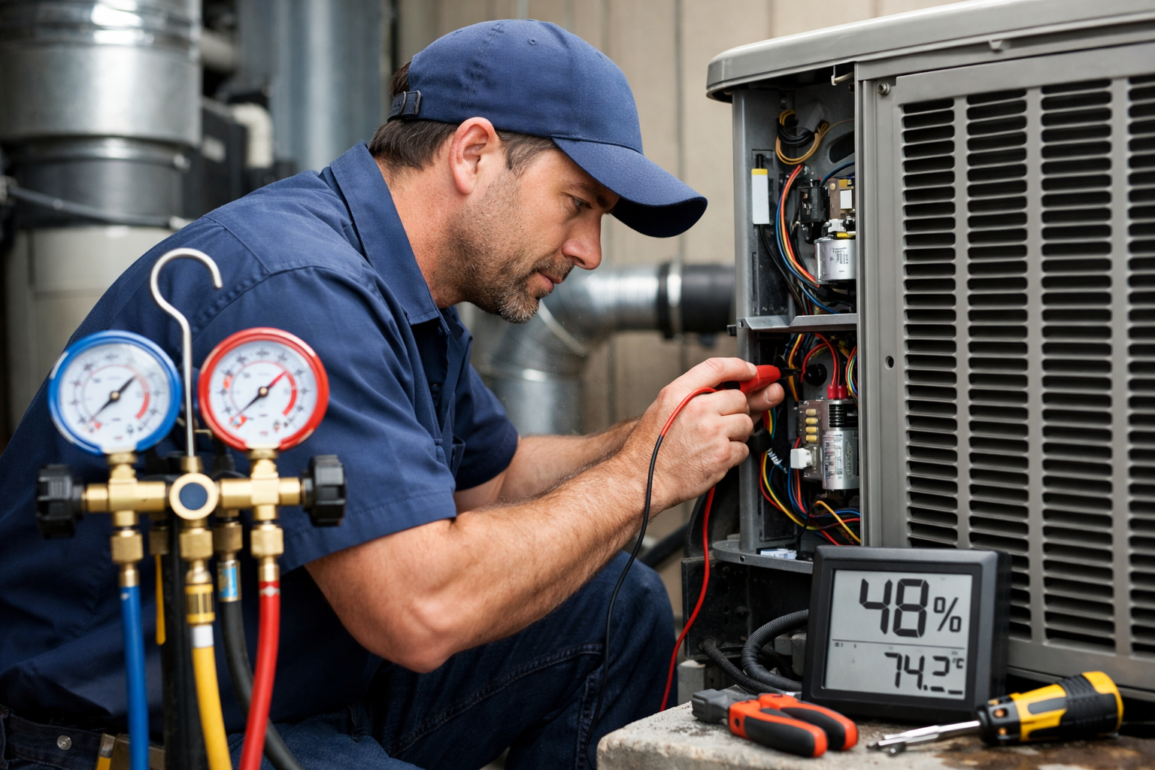
• Fix humidity, not just temperature. This HVAC repair case study shows how better system matching and heat pump performance helped a home hold 48% indoor humidity and feel cooler at 75°F.
• Compare HVAC repair cost against long-term waste. If your unit struggles on every floor, runs constantly, or spikes energy bills, a repair-first review can show whether service, maintenance, or replacement makes better financial sense.
• Use the $5000 rule carefully. It can help frame an HVAC repair vs replacement decision, but furnace age, system efficiency, parts availability, and recurring repair history matter just as much.
• Watch the common trouble spots first. Dirty filters, thermostat issues, low airflow, condensate backups, and blower motor problems are some of the most common HVAC repair calls and often point to bigger comfort issues.
• Choose local HVAC service that can move fast. In Jacksonville heat and First Coast cold snaps, a company with available technician support, stocked parts, and 24/7 repair service can save you hours of discomfort and prevent bigger system damage.
A Jacksonville home can turn miserable in a hurry when the AC runs all day, the air stays sticky, and the second floor still won’t cool down. That usually isn’t bad luck. It’s a sizing issue, airflow trouble, a failing blower motor, a clogged filter, a thermostat mismatch, or a condensate problem dragging the whole HVAC system down. And when people need HVAC Repair now—not three days later—a fast, local service company makes all the difference.
This article walks through a real comfort problem and what changed after a repair-first evaluation centered on system matching, heat pump performance, maintenance history, and indoor humidity. It also gets into what homeowners should expect from 24/7 residential service in Jacksonville, how repair cost stacks up against replacement, and which issues show up again and again in furnace, air conditioner, and heating equipment. High energy bills, uneven rooms, a unit that just feels off—this is the stuff that actually moves the needle.
HVAC Repair in Jacksonville: What Homeowners Should Expect From a 24/7 Residential Service Company
Why urgent HVAC repair matters in Florida heat and First Coast cold snaps
In Jacksonville, HVAC Repair isn’t some nice-to-have call. It’s an emergency the moment the air conditioner dies at 6 p.m. in July or the heat cuts out during a First Coast cold snap. A residential home turns sticky, miserable, and flat-out unsafe in a hurry—especially for kids, older adults, tenants, and anyone working from home.
A local company offering 24/7 service should actually mean it. Fast dispatch. Clear communication. A technician who arrives ready to diagnose the full hvac system instead of taking wild guesses. Homeowners searching for AC repair near me or HVAC repair near me aren’t looking for polished sales talk. They want the cooling or heating back on. Tonight.
What a fast diagnostic visit should check: thermostat, filter, condensate, blower motor, and outdoor unit
Here’s what a real diagnostic visit should cover before anyone starts pushing replacement:
- Thermostat: wrong settings, bad staging, dead batteries, or failed communication
- Filter and filters: clogged return airflow can choke a unit in days, not months
- Condensate system: a full drain pan can trip the safety switch and shut the system off to stop a flood
- Blower motor: weak airflow, odd noise, or no air from vents often points here
- Outdoor unit: frozen coil, low refrigerant signs, damaged condenser parts, or a struggling compressor
Most people miss the obvious stuff. A dirty filter, a backed-up condensate line, or a thermostat problem can look exactly like a bigger furnace or pump failure. And in real hvac service, a sharp technician checks those basics first—fast—before digging into system performance, motor operation, and airflow across each floor.
Why local HVAC service beats waiting days for parts, tools, and technician availability
Speed matters. Preparedness matters more. A local Jacksonville hvac company usually outruns out-of-area scheduling because it already covers Duval, Clay, and St. Johns Counties, and the technician often has common parts, tools, gauges, filters, a thermostat, and even a blower motor riding on the truck. That changes the whole repair timeline.
Why sit around for three days waiting on a callback when the blower motor or thermostat issue can be handled in one visit? With HVAC Repair and real local service, a nearby team can often inspect the system, explain the cost and price, and finish the repair in the same hour block or later that day. That’s huge for residential rental house owners — one rough night can turn into tenant complaints, humidity, heat, air conditioner strain, and bigger furnace repair or heating service headaches fast.
And for homeowners also looking into duct cleaning near me, a smart company won’t just sell noise. They’ll say what matters: whether dirty ductwork, vents, vent covers, a register, diffuser, filter, plenum, damper, or condensate issue is actually part of the problem, or just a side concern. Not every comfort problem starts in the ducts. Some come from poor sizing, bad staging, weak maintenance, an inefficient unit, or a tired conditioner that never really matched the home.
HVAC Repair Case Study: How Correct System Matching Improved Heat, Air Conditioner Performance, and 48% Indoor Humidity
The original problem: poor comfort, high energy use, and a system that felt wrong on every floor
One Jacksonville-area case stood out for a simple reason: the complaint was painfully familiar. The house never felt right. One floor stayed warmer, humidity hung in the air, and the owners kept dropping the thermostat to 70°F but still felt sticky. Their energy use wasn’t pretty either.
That kind of call often gets tagged as simple HVAC Repair, but that’s not always the real story. Sometimes the bigger problem is system mismatch. If the unit is oversized, undersized, or paired badly with the duct layout, the home can cool fast without pulling out enough moisture. So people blame the thermostat, the filter, or the brand—and miss what’s actually wrong.
The repair-first evaluation: Manual J sizing, duct concerns, thermostat staging, and heat pump performance
The evaluation started with repair-first thinking, not automatic replacement. Smart call. The service team looked at:
- Manual J load details tied to square footage, windows, and insulation
- Duct concerns affecting airflow and room balance
- Thermostat staging to make sure the system wasn’t cycling poorly
- Heat pump performance and dehumidification behavior in real conditions
Here’s the thing: a unit can run and still perform badly. That’s common in Florida homes. Better matching matters because humidity control isn’t just about cold air. It’s about run time, airflow, heat transfer, and how the whole hvac system works together.
The result: a matched Trane, Carrier, Lennox, Goodman, or Ruud-ready approach that helped the unit feel cooler at 75°F
Once everything was properly matched, the home settled in at about 48% indoor humidity. That’s a number people actually feel. Not just something buried in a report. The owners said the house felt cooler at 75°F than it had before at 70°F. And their JEA bill dropped by 28%, which says plenty.
The brand name wasn’t really the story. Trane, Carrier, Lennox, Goodman, or Ruud—it still comes down to how well the system matches the home, the thermostat, and the duct conditions. A high-efficiency conditioner, by itself, won’t rescue bad sizing. It just won’t.
What this HVAC repair case study says about maintenance, replacement timing, and long-term cost
This case says something property managers usually learn the hard way: maintenance matters, absolutely, but it can’t save the wrong equipment forever. Clean filters, tune-ups, and proper service help. But if the unit was the wrong fit from day one, repair after repair starts piling up.
And that’s when cost stops being a short-term annoyance and turns into a long-term problem. A repair-first company should say that plainly instead of selling panic. Sometimes the right call is a targeted fix. Sometimes it’s replacement, with matched installation and a performance audit.
HVAC Repair vs Replacement: How to Decide Based on Cost, Age, Furnace Condition, and System Efficiency
Using the $5000 rule for HVAC without oversimplifying the real repair decision
Homeowners ask about the $5000 rule all the time. The basic math is simple: multiply the age of the system by the repair cost. If that total climbs past $5,000, replacement deserves real consideration. A 12-year-old unit with a $500 repair lands at $6,000, so the numbers point toward replacement.
But that rule isn’t gospel. A well-kept residential heat pump or furnace with a solid maintenance history may still be worth fixing. A badly matched system with weak airflow, repeat condensate trouble, and rising energy use? That’s a different story.
Common HVAC repair problems: blower motor failure, condensate backups, dirty filters, thermostat issues, and low airflow
Most repair calls land in a few familiar buckets:
- Blower motor failure causing weak or no air movement
- Condensate backups shutting the system down at the safety switch
- Dirty filter or filters restricting airflow and stressing the unit
- Thermostat issues including calibration, wiring, or bad staging
- Low airflow from duct problems, a tired motor, or a dirty coil
Sometimes homeowners spot a blinking light, a stuffy room upstairs, or a strange sound drifting out of the furnace closet. That matters. And so does noticing whether the trouble is hitting just one floor. Those small clues can steer the technician to the actual failure a whole lot faster.
When furnace repair, heat pump service, or full HVAC installation makes more sense than another fix
If the furnace repair is minor and the heat exchanger, blower, and controls are sound, a repair can make sense. If a heat pump is newer and the issue is isolated to a capacitor, thermostat, or drain problem, service is usually the better call. Pretty simple.
But some homes get stuck with the same failing unit every season. Cooling in summer. Heat in winter. Humidity all year. At that point, full HVAC installation or replacement usually beats another patch job—especially when the current system was never sized correctly in the first place.
How efficient equipment, trained technician work, and proper parts matching affect repair cost over time
Cheap repairs usually come back to bite. The wrong parts, messy wiring, bad vacuum practice, and half-done airflow checks lead to repeat service calls—and that gets expensive fast. A trained technician with the right tools, solid training, and real hvac experience will usually save homeowners money over 2 to 5 years because the repair actually lasts.
Ask one simple question: is this fix solving the problem, or just buying two more weeks? That’s the line. Smart service versus wasted money. Good distributors and factory-backed parts matter too, no question, but install and setup still make or break the result.
For Jacksonville homeowners comparing furnace repair, AC repair near me, or full replacement, the smartest move is a company that explains both options in plain English and shows the numbers without pressure.
HVAC Repair FAQs: Cost, Allergies, Common Problems, and Jacksonville Service Questions
What is the $5000 rule for HVAC?
The $5000 rule is a quick screening tool—not the final answer. Multiply system age by repair cost. Simple math. If the total climbs past $5,000, replacement usually makes more financial sense. Example: a 10-year-old hvac system needing a $650 repair equals $6,500. At that point, you should look hard at replacement, installation quality, and energy savings.
How much does HVAC repair cost?
HVAC Repair cost comes down to the failed part, the labor hour count, and whether the company already has the parts sitting on the truck or back at the shop. A clogged condensate line or thermostat service usually lands at the lower end, while a blower motor issue or major outdoor unit repair hits harder. And after-hours calls? They can push the price up fast. Homeowners should ask for a clear breakdown of the diagnostic fee, parts, labor, and whether the repair affects future replacement credit.
What HVAC systems are best for allergies?
For allergy concerns, the best setup is usually the one that controls humidity well and supports good filtration. Real improvement in air quality usually comes from a matched system, clean filters, and steady airflow—not from chasing brand names alone. In Jacksonville, lower indoor humidity can make a house feel cleaner and more comfortable fast.

Most people think only about temperature. But that’s not the whole story.
What is the most common HVAC problem?
The most common hvac problem is restricted airflow. Dirty filters, blower trouble, thermostat glitches, and condensate shutdowns show up constantly on residential service calls. Low airflow strains the system, drags down heat and cooling performance, and pushes energy use higher. When a unit keeps running but the house still feels muggy, uneven, or just off, that’s usually where the technician begins the repair.
And when a homeowner keeps resetting the thermostat but comfort doesn’t budge, that’s the tell. Something deeper in the system needs service.
Frequently Asked Questions
What is the $5000 rule for HVAC?
The $5000 rule is a fast, practical way to judge HVAC Repair versus replacement: multiply the repair cost by the age of the system. If that number lands over 5000, replacement usually makes more sense. But it isn’t some iron law. In Jacksonville, I also look hard at humidity control, energy use, repeat service calls, and whether the furnace, heat pump, blower motor, or condenser is still worth saving.
How much does HVAC repair cost?
HVAC repair cost comes down to the failed parts, the brand, and how quickly you need service. Some fixes are cheap, plain and simple—a clogged condensate line, dirty filter, bad thermostat, or failed capacitor usually won’t hit like a compressor, motor, or major system repair. But after-hours calls, older units, and hard-to-find Trane, Carrier, or Lennox parts? That can drive the total up fast.
What HVAC systems are best for allergies?
For allergies, the best hvac setup is the one that keeps air clean, humidity steady, and filters doing their job without strangling airflow. A properly sized residential system—backed by solid maintenance, quality filtration, and real ventilation—usually does far more than buying a flashy conditioner or furnace and hoping that single unit fixes the whole house. I’ve seen it over and over: better allergy relief comes from the full system working together, not some magic box.
What is the most common HVAC problem?
The most common HVAC repair issue? Poor airflow. Usually, it comes from dirty filters, a clogged coil, thermostat trouble, or a failing blower motor. In Florida home settings, condensate drain backups are right up there too—especially when the unit runs hard for a long hour stretch. And small problems snowball fast if maintenance gets skipped.
How do I know if I need HVAC repair or full replacement?
If your system keeps breaking down, can’t heat or cool evenly from floor to floor, or is sending energy bills through the roof, replacement is usually the smarter move. But if the issue is isolated—a thermostat, pump, motor, contactor, or condensate problem—HVAC repair may be all you need. A good technician should lay out both options straight, with real numbers. No dancing around it.
Can I run my HVAC system if it’s leaking water?
No—don’t keep that hvac system running until the leak is checked. Water around the unit usually means a clogged condensate drain, a full drain pan, a float switch problem, or an airflow issue that’s causing ice. And if you let it keep going, you’re asking for ceiling damage, wet floor trouble, or a much bigger repair bill.
Why is my HVAC unit running but not cooling or heating well?
A weak hvac system usually comes down to a handful of usual suspects: low refrigerant, a dirty filter, bad thermostat settings, blocked airflow, failing blower parts, or an outdoor conditioner section that just isn’t doing its job. And sometimes the unit is on, sure, but it still isn’t pushing enough air or pulling out enough heat. That’s exactly why a real HVAC repair service checks the full system instead of guessing.
Do all HVAC brands use the same parts?
No—and that trips people up all the time. Some universal parts do work across brands, sure, but plenty of components are tied to a specific model, especially on Trane, Carrier, and Lennox equipment. A good hvac company usually keeps the common tools and parts close by for repair and service, but tougher HVAC Repair jobs may come down to distributor availability and the exact unit installed.
How often should residential HVAC maintenance be done?
Twice a year. That’s the right rhythm for most residential hvac systems—once before heavy cooling season, then again before heating season kicks in. Regular maintenance spots weak motor trouble, dirty filters, drain issues, loose wiring, and thermostat problems before they become emergency repair calls. And it keeps the system energy efficient while helping protect warranty coverage.
Is emergency HVAC repair available after hours?
Yes—some HVAC repair companies do offer 24/7 service for after-hours breakdowns. In Jacksonville, that matters. Losing air conditioning in extreme heat isn’t merely annoying; it can get serious in a hurry. If you’re calling at night, ask about response time, diagnostic cost, and whether the technician can handle repair or replacement on the spot.
For Jacksonville homeowners, the takeaway is straightforward: comfort problems usually have a cause, and it isn’t always “the unit is old.” A house that feels damp, uneven, or warmer upstairs often points to a mismatch between equipment, airflow, controls, and real load conditions. That’s why solid HVAC Repair starts with diagnosis, not guesswork. A technician should check the thermostat, filter, condensate setup, blower operation, outdoor equipment, and how the whole system is actually performing in the home.
And this case study makes another thing obvious in Northeast Florida—proper matching matters a lot. When the system is sized and staged correctly, humidity can drop, rooms can feel better at higher thermostat settings, and energy waste can ease up instead of climbing month after month. Sometimes a targeted repair is the right call. Sometimes replacement is smarter. It comes down to age, condition, efficiency, and whether the fix actually solves the problem or just buys a little time.
If a Jacksonville-area home is running muggy, uneven, or just flat-out failing after hours, the next move is obvious: schedule a 24/7 diagnostic visit with Always On Air AC at 904-532-3389 and get the system checked before the next hot night or cold snap hits.
Always On Air AC
| 📍 | 9633 Old St Augustine Rd, Jacksonville, FL 32257 |
| 📞 | (904) 532-3389 |
| 🌐 | https://alwaysonairacs.com/ |